

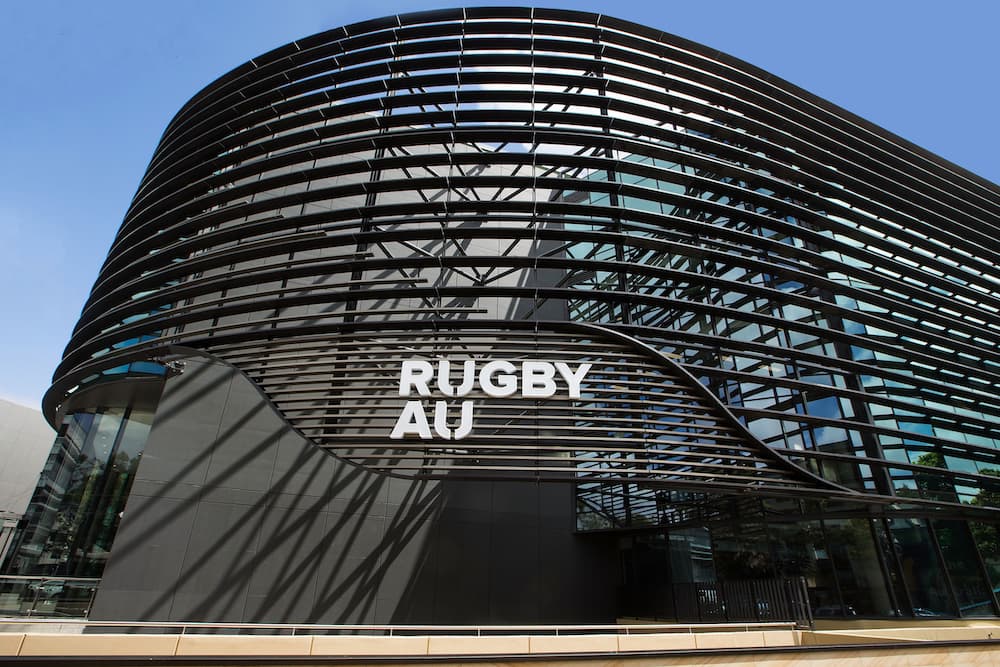
Rugby Australia (Rugby AU) today announced its 2017 results at its Annual General Meeting, held at the Rugby Australia Building in Sydney.
In 2017, Rugby AU continued working under its revised 2016-2020 Strategic Plan, which provides a framework for Australian Rugby to achieve its vision: “To inspire all Australians to enjoy our great global game”.
Rugby AU recorded a surplus of $17.8m in 2017 ($3.7m surplus in 2016), however $21.6m of this was Government funding specifically for the development of the Rugby Australia Building, the game’s new high performance and administrative headquarters at Moore Park.
Without this one-off, special purpose funding, operationally Rugby AU recorded a deficit of $3.8m in 2017.
Rugby AU’s financial position was impacted by poorer than forecasted Test match tickets sales, as well as other one-off costs relating to the Super Rugby restructuring process and decision to discontinue the Western Force Super Rugby licence. The decision to reduce Australia’s Super Rugby representation to four teams greatly impacted the overall public sentiment around Rugby but it was made to secure the game’s immediate financial health and to allow the organisation to direct more meaningful investment to community Rugby, which is a priority for Rugby AU in 2018.
Significant highlights from the year include:
- Women’s Rugby continued its impressive growth, with Women’s Club XVs participation climbing 53%, while female Club Sevens participation increased by a further 47% a year after the Rio Olympic Games.
- In addition to this, Rugby AU strengthened its commitment to developing the Women’s pathway with the inaugural eight-team Aon Uni 7s series kicking off. This tournament, the first of its kind in Australia, proved hugely successful and will play a crucial role into the future in nurturing the next generation of Australian Women’s Sevens stars.
- Indigenous Rugby participation rose by 134%, owing largely to the success of the ‘Deadly 7s’ program in schools. The Qantas Wallabies also marked the organisation’s sharpened focus on Indigenous participation by becoming the first national team representing Australia to take the field in an Indigenous-inspired jersey for the final Bledisloe Cup clash in Brisbane.
- Rugby AU’s primary schools program ‘Game On’ provided 56,374 students with an introduction to Rugby through lessons in the classroom and on the playing field. Significantly, 68% of participants were from Government schools and 40% were female.
- Rugby AU strengthened its commitment to the safety and inclusion of all participants in Rugby with a roll-out of national initiatives and policies to encourage children to play, and stay, in Rugby. This included the implementation of a specific Safety and Participation Policy, an updated Age Dispensation Policy and a national Blue Card trial in relation to concussion management.
- Establishment of a national high-performance panel, Chaired by former Wallaby and current Rugby AU Vice Chairman Brett Robinson, and including representatives from Rugby AU, the Super Rugby clubs, the Australian Sevens program, and RUPA. In late 2017, a collaborative national high-performance implementation plan was finalised, titled ‘One’ plan.
- The Qantas Wallabies introduced 14 new debutants in 2017 in the lead up to the 2019 Rugby World Cup.
- Wallabies Assistant Coaches Stephen Larkham and Nathan Grey committed full-time to the Qantas Wallabies having served the national team in a part-time capacity previously.
- A further 11 capped Wallabies made long-term commitments to Australian Rugby by signing new contracts in 2017, including stars Kurtley Beale, Tevita Kuridrani, and Adam Coleman.
- Construction was completed on the (State and Federal) Government-funded Rugby Australia Building, which includes a world-class high-performance facility and is the first fully-fledged home base for all of Australia’s national teams, as well as Rugby AU’s administration.
- The Buildcorp Wallaroos finished 6th in their 2017 Rugby World Cup campaign in Ireland, securing automatic qualification for the 2021 Women’s Rugby World Cup.
- The Australian Rugby Foundation (ARF) invested $800,000 across its four pillars of high performance, grassroots Rugby, Women’s Rugby and Indigenous Rugby. Significantly, the ARF pledged $234,000 to support the Buildcorp Wallaroos’ Rugby World Cup campaign.
- Engagement in the National Rugby Championship (NRC) grew with a 14% increase in crowd attendance and record viewership of 150,000 viewers across Pasifika Round following the introduction of the Fijian Drua, the competition’s first international team.
- Rugby.com.au reported sharp growth on the back of its live streaming of all national non-professional Rugby competitions, with four million minutes of vision streamed from these tournaments across the website and Rugby AU’s social media platforms.
- Entry of a new ‘all of game’ collective bargaining agreement with the Rugby Union Players Association (RUPA) and Super Rugby clubs that achieved pay equality for entry-level minimum contracts for Super Rugby players and Men’s and Women’s Sevens players for the first time in the professional era (finalised in early 2018).
In 2018, Rugby AU will focus on bolstering its investment in community Rugby and improving the connection in the game between the grassroots and professional levels with an emphasis on community coach development.
There will also be further refinements in community Rugby to improve player safety and welfare and an expansion of the Game On program, which is now known as ‘Get into Rugby’ across schools and Clubs.
Another major priority in 2018 is improving performance of professional teams through the collective implementation of the collaborative ‘One’ high performance plan and the establishment of a Women’s high-performance leadership program.
Rugby AU will also step-change its approach to Women’s Rugby to ensure all departments work together to capitalise on the momentum generated by Super W and Women’s Sevens success.
A key pillar for the advancement of Women’s Rugby will be securing the hosting rights for the 2021 Women’s Rugby World Cup.
There will also be a renewed marketing approach to highlight Rugby’s strengths at all levels of the game and a further push to boost fan engagement through Rugby AU’s digital platforms.
Rugby Australia Chairman, Cameron Clyne said: “2017 was an incredibly difficult year for Australian Rugby. The difficult decision to remove a Super Rugby team was made with the game’s best interests at heart, but it resulted in a great deal of hardship.
“Ultimately, we believe the decision will strengthen our code in the long term. We want to be able to invest more significantly in community Rugby, something we have often been unable to do confidently over the past five years. We also want to improve our performances at the highest levels of the game and we will continue to invest in our new collaborative high-performance model.
“Despite the significant challenges of the past year, there were some great highlights including huge participation growth in Women’s Rugby and Indigenous Rugby, and the inaugural Aon Uni 7s and advent of the Buildcorp Super W competitions to bolster our female pathways.
“At the community level we have also made great advancements in improving the safety of our game, which is crucial to continue to attract young boys and girls into the sport.
“I also want to thank our outgoing Board Directors and former Rugby Australia CEO, Bill Pulver for their outstanding service to Australian Rugby,” said Clyne.
Rugby Australia Board electionsThe AGM included the election of two new Board Directors, Mr Hayden Rorke and Mr John Wilson, who replace outgoing Directors, Ms Elizabeth Broderick and Mr Geoffrey Stooke.
Mr Rorke is deeply entrenched in community Rugby having been a player, coach and administrator through 50-plus years of association with Gordon Rugby Club in Sydney. He most recently served as the Club’s President and has over 37 years’ experience in the pulp and paper industry.
Mr Wilson has a long association with Rugby which began in Victoria with Melbourne University Rugby Club and most recently as Chair of the Australian Rugby Foundation. He is a Senior Advisor at Goldman Sachs and has held several other high-profile roles in his 30-plus years in business.In addition, Mr David Codey was elected as Junior Vice-President, replacing outgoing Junior Vice-President, Mr Jeff Miller, who resigned from the role after taking up a Board Director position with Queensland Rugby Union (QRU) in 2018.
The AGM also heard the anticipated retirement of Board Director Mr John Eales. Mr Eales has been a Director of Rugby Australia for eight years, and the maximum term for a Director is nine years. He has announced he will step down as a Director in the second half of 2018. It is anticipated that former Wallabies Captain, Mr Phil Waugh will be nominated to replace Mr Eales on the Board.


